Showing posts with label orchids. Show all posts

Saturday, July 29, 2017

Catasetum Fever

I really like Catasetums. I really like most of the species and many of the hybrids. They've fascinated me since the days of my first Jones and Scully orchid catalogues back in 1984. The images of Cstm. Orchidglade made my mouth water. But it was years before I actually grew a Catasetum. I ended up with two that were smallish and, as a bonus, semi-reliable bloomers. I was happy for many years.

Clowesetum Raymond Lerner

Ctsm atratum (I still think)
But then Fred Clarke and Sunset Valley Orchids came on the scene, and I longed for more. I hesitated. Most of those hybrid plants eventually become HUGE, especially the Ctsm pileatum hybrids. I don't have overhead space for plants that get even a foot tall. I continued to hesitate. Then the ever-inventive Mr. Clarke decided to try breeding MINI Catasetums. Oh no. I got one. It bloomed! (It's not doing so great right now, but I have hopes for its revival.)


Ctsm Karen Armstrong (Susan Fuchs x denticulatum) is a building block hybrid for the new minis SVO is creating. And creating, and creating. There are a lot of new hybrids available, and some are kind of meh and others are really exciting.

This spring, SVO had a big sale on their unbloomed seedlings in 3-inch pots. So I went in on a group order with friends, and I somehow (hah) ended up with five new Catasetum plants. Well, actually 4, since I ended up with two of one cross. Group orders tend to include surprises, after all. Some sell-outs, some extras.
Ctsm. Double Down (Ctsm. Chuck Taylor 'Wow' x Ctsm. kleberianum 'SVO) (2)
Ctsm.(Ctsm. gladiatorium 'SVO 35' x Ctsm. barbatum 'SVO' HCC/AOS)
Fredclarkeara (Mo. Painted Desert 'SVO' HCC/AOS x Ctsm. Alexa 'Good One')
Fredclarkeara (Mo. Painted Desert 'SVO' HCC/AOS x Ctsm. Karen Armstrong 'SVO')

Here they are, fresh out of the box.
And already sprouting!
Most of these babies were already developing new roots on the new shoots. Because I am an indoor grower with lousy humidity levels, I began watering them right away. Older pseudobulbs should not shrivel as the new growth expands, and if you don't water them enough that will happen. The plants won't grow as heartily as they should.

The popular wisdom is to keep these sprouting plants dry so their roots will hungrily seek moisture and grow rapidly, while the sprout lives off the water stored in the older bulbs. A very humid atmosphere helps keep the plants going. But honestly, in their native deciduous forests, substantial amounts of morning dew often soak the plants at this stage so I say the hell with pop wisdom and just water the damn things. Especially since I popped them out of their pots to check root growth, and I saw no issues, just lots of nice healthy white roots.

I did wait just a tad too long to actually repot them, but they didn't seem to mind.


The old tiny pots were completely packed with roots by now, and so I just popped them into bigger pots and filled in with seedling mix. Once they go dormant and the roots die back, I'll clean them up and repot them properly. Probably.

The first one to spike and bloom was this (gladiatorium x barbatum):


It's got spots and a fringy lip from both parents, not quite best of both (which are very similar) but pretty nice. It's a great flower count for a first-bloom seedling!

Two other people also had this cross bloom first. So it's a great choice for even beginners with this group of hybrids! That same plant pictured now has a second spike filled with buds. I'm seriously thrilled with it.

I'm curious to see if the Fredclarkeara hybrids will wait to spike until they've dropped their foliage, the way Mormodes species usually do. (I won't have long to wait for two of them, since uh, they were fiercely attacked by spider mites and my battle waged didn't prevent premature leaf drop.) 

I'm happy to have these plants doing fairly well...this summer has been a bummer for my plants overall. Mostly my fault, not watering sufficiently even though I started out well feeding and misting. I'm trying to make amends and see what the rest of summer holds.

Wednesday, July 12, 2017

Southern African Epiphytic Orchids, by John S. Ball


At one point I obsessed over collecting rare or unusual orchid books, aided and abetted by several friends who also delighted in used bookstore finds or eagerly and impatiently awaited new publications. Magpie, you know. I was so eager to expand my knowledge of ALL types of orchid I'd read pretty much anything. I honestly don't remember how this wonderful old book ended up in my collection, it might have been a gift or a lucky purchase.

Epiphytic Orchids of Southern Africa is a treasure. The paintings by Patricia van de Ruit are exceptional, made life-size for the oversize pages. The book was published in 1976 after Ball's death, from his detailed notes, and edited by his sister, Jane Browning, with the assistance of Peter Ashton.

The plants depicted include a number of species even now only rarely seen in cultivation in the US. Thanks to people like Fred Hillerman back in the 60s, 70s and 80s whole tribes of Angraecums, Aerangises and related genera were introduced to our collections, and my friends in New York in the 80s included several fanatics who had to have all the plants and all the books. Nowadays many of the species are somewhat easier to come by, and many are raised from seed. This book is still a great place to learn more about them.

I'd love to get his other posthumously published book Terrestrial African Orchids. To quote the blurb on Lulu.com, "The 128 orchids illustrated in this work were collected from the wild in many localities by the late John S. Ball, mainly during the early 1950s when he worked as a forester in the Melsetter area close to the Chimanimani Mountains in Zimbabwe. Many of the species from this area are recorded to the North in the Flora of Tropical East Africa floristic region and to the South in the Republic of South Africa, particularly in KwaZulu-Natal. In 1978 John Ball's work on epiphytic orchids from this region was published in the book Southern African Epiphytic Orchids. The present work is edited by Jane Browning (John Ball’s sister) assisted by Esmé Hennessy."

Ball was one of those obscure but vital people in science, Born in 1926 in Rhodesia, he was also a Rhodes scholar, and then returned to Africa to work in forestry. He died in a car accident in 1976. It's a pity he never got to see his books published and enjoyed.

Saturday, December 5, 2015

Habenaria rhodochila, Superstar


I love love love love love terrestrial orchids. I've been growing several kinds for many years now. While it seems silly to "waste" precious indoor light garden space on plants that vanish entirely for half the year, it's not much sillier than growing other species that bloom sparingly. And for that half year underground, they're no trouble at all!

My pink Habenaria rhodochila has been very happy for the past six years, but I've never been thrilled by the flowers. They're wimpy. The color isn't bad, but the shape is blah -- too open, compared to others I've seen And no matter how close to the lights I put the developing new shoots each year, the plants end up stretched out. But it still blooms like crazy! And this year, the ever-growing tuber put up a whopping seven new growths, five of which bloomed! I really can't help but love the darn thing, even if those flowers only last a week. A WEEK. Well, having five spikes stretched the flowering period to about a month. But really.

Being nevertheless eager to expand my collection, I was happy to win a tiny plant of the orange form of the species at auction. It came from my friend Ron Midgett at New Earth Orchids, who has excellent taste in Habenarias. I figured it was a good bet the flowers  would be decent, but didn't expect any until 2016.

Surprise! The tiny plant grew and grew over the summer, and soon put up a spike with several buds. It took a long time for those buds to develop. Good? Bad? Neither? The stem is really straight, really sturdy. Then the buds started to open...

This plant's flowers aren't wimpy. They're amazing. And they've been open over two weeks already. I took the plant to work in a cereal box wrapped in plastic bags, then on an express bus for a trip to the Greater NY Orchid Society show table, and wow, not one sign of wilting yet. I hope they make it to the Manhattan Orchid Society show table next week!

Everyone wants to see it next year, when the plant is bigger. I just hope like all hell I don't somehow manage to kill it this winter...I'll be VERY careful once it settles in for its seasonal nap.


ADDENDUM: The flowers ended up lasting FIVE WEEKS. The plant is now (very early January) thinking about going dormant.


Sunday, November 15, 2015

Catasetum Karen Armstrong FLOWERS YAY OMG!!


Fred Clarke of Sunset Valley Orchids rules the orchid universe. Well, at least parts of it. The Catasetum part, certainly. He has an eye for parent plants and a knack for making incredible crosses that are new things to the eyes of the world. After all, he made an orchid so very near black -- Fredclarkeara After Dark -- that digital cameras have a hard time revealing details and many of the images are just sort of blobby. (Really good photographers are able to overcome this challenge. Not so most of us.)

I've had a couple of Catasetums for years now, and itched for another from SVO. One of Fred's pioneering efforts is to create "mini" hybrids in this group, using species known to stay small and keep their offspring small as well. Well, that fits my plans, and my light garden, mighty well! So when Fred was speaking in New Jersey last year, a friend picked out a near-blooming-size Catasetum Karen Armstrong for me. It seemed pretty much ideal for my light garden conditions based on its parentage. I took good care of the plant through its brief dormancy, and was rewarded with an enormous new growth. And was further rewarded with a spike!

Catasetum Karen Armstrong is the hybrid of Ctsm. Susan Fuchs (expansum x Orchidglade) and Ctsm. denticulatum, so it combines "old style" mega-Catasetums with the species most notably being used to create the "mini" Catasetum hybrids. CKA is a great building block parent, but it's also a great plant in its own right. I wuv it. Trouble is now I want more...

Friday, May 9, 2014

Dendrobium faciferum


As an orchid grower with limited space, I end up torn between wanting to stick to a (rather nebulous) wish list for orchid purchasing, and taking joy in serendipity. Attending at least 3 or 4 orchid shows/sales per year ensures a bit of both: I'll always find at least one thing I actually know I want, and several things I had no idea I wanted until I saw them.

Dendrobiums are so varied, so wondrously diverse, it's impossible to make blanket statements about them. I know several people who are sworn dendrobium fanatics for that very reason. You can experience such a variety of types of orchid all within one genus swarm! Monstrous things that resemble garden shrubs, tough little mats of nubby succulent leaves clinging to rocks, masses of slender leaves like bunches of upside-down onions, flowers that last for nearly a year, flowers that last for a mere hours, hardy beasts needing frost to provoke flowering, dainties that suffer the merest hint of cold...

Dend. faciferum was a happy happenstance purchase at a show just over a year ago, and kinda had me worried for a while that it didn't like me. This sweetie supposedly likes warm to hot temperatures and plenty of water (allowed to dry a bit between waterings though), which is no problem for me; I worried the light wasn't bright enough at the ends of the T-12 tubes. But once I switched to T-8 fluorescent tubes above it, the plant was clearly happier. Flowers commenced! Two growths made these lovely bunches of glowing orange flowers, which make quite pleasing contrast with the deep green ovary stems. They last about 10 days, so far.

Hoping for new growth soon -- repotting seems in order as the plant is a bit too deep in its current tiny pot and a couple of older growths recently yellowed and popped right off the clump.


Sunday, July 28, 2013

Clowesetum Raymond Lerner


It seems hard to believe I've been growing orchids under lights alone for 20 years now. That is to say, for twice as long as I grew orchids on windowsills. And I still have so much to learn. Changing over from T-12 to T-8 light fixtures is going slowly, but excellent results so far. More light for the same $$, and the plants really seem to enjoy that wider-spectrum boost.

I picked up this Clowesetum Raymond Lerner not long after I was forced into all-lights growing. I absolutely love Catasetums, and desperately wanted to try growing one even though bringing a large deciduous plant into a limited space setup was, frankly, crazy. I knew Catasetum pileatum could get quite large, but hoped the Clowesia russeliana parent would keep the plant size down. I totally lucked out...not long after I got mine, I saw one at an orchid show that was ENORMOUS, with two really long spikes full of flowers that looked very much like the Clowesia. But my plant stayed pretty compact.

For 10 years, it bloomed with a couple of flowers every 2 years. It piddled along, growing but not really thriving. Repotting definitely helped. Feeding helped. But then the next 10 years were sad. Even while other orchids were making me happy, the CRL was not happy. It only bloomed three times, and one time the spike blasted. I was not happy. The back bulbs shriveled, as they will in this genus. Repotting time again.

And a big rethink of the rest period. Warmer and brighter, as Fred Clarke and other Catasetum geniuses say, is better. So after the leaves died, I stuck the plant, still in only a 6" pot, on the bottom shelf of my lights off to the side a bit, instead of on the Windowsill of Exile and Doom. Watered it every 7-10 days to keep it alive, as the winter humidity is root-puckeringly bad. Watched

This spring, the second year in the "new" mix, I saw nice upright aerial "basket" roots forming, on a really nice fat new bulb growth. Yay! I decided to keep it where it was, as the leaves seemed quite OK from the amount of light they were getting -- near the center of the T-12s, but a couple of inches away to the side.

I was being really good about feeding my plants this spring. And I spritzed everything like mad, once a week, with MegaThrive, including the Catasetum.

And then the spikes appeared. TWO of them. This happened.

Needless to say, I'm going to be really nice to this plant from now on.


Tuesday, May 28, 2013

Angraecum didieri


Mini Angraecums are a peculiar addiction that has affected all too many of my friends. Surely such small plants could hardly be a problem...and then you have twenty of them, all of costly, several needing Special Conditions or at the very least a bit of coddling. In return, you may or may not get lovely fragrant white flowers in varying quantities, for varying periods of time. Sounds fair to me!

My personal forays into the Angraecoids were mostly limited to Aerangises, which have performed poorly for me. Or I let them down. Either way, I decided to give up. But lo! Last year Cal-Orchid released a large selection of Angraecum didieri, multiple growths, in spike or just blooming size. I had to have one.

I flowered it, and then nearly killed it. What the hell! Yellowed and then browned leaves, bottom to top. The crowns barely hung on. I suspected thrips and washed the plant. I doused with cinnamon. I watered, spritzed, shifted to another spot. It sulked. It did nothing at all but remain alive. I suspected I'd overwatered and cut back a bit. The mix seemed OK, so I didn't mess with that.

So naturally I got another one this spring, when opportunity arose. And...

Well, it sort of sat there for a month, which wasn't surprising, really. Tentatively, it made a leaf from one of the two growths. Extended a few root tips. Sat there some more. The two tantalizing spikes did nothing. It got watered with everything else, with both plain water and MSU fertilizer (at irregular intervals). Then I decided to finally open the bottle of MegaThrive I got late last year, and spray it all over everything, twice a week.

Buds and flowers on EVERYTHING. Well, not everything. But the newer Ang. didieri burst into bloom literally within ten days of being sprayed. One of the tantalizing spikes evolved nearly overnight. One more tantalizing spike remains...

The older plant, meanwhile, remains alive. It now clearly needs repotting, along with a couple dozen other plants, so hope springs eternal.

Tuesday, March 19, 2013

Where have all the orchids gone...?


So like all orchid collections, mine has an ebb/flow thing that goes on. New plants come in. Old plants go bye-bye. Sad but true. What comes home from the orchid show in big bags quietly leaves the apartment in small bags...*sigh.*

With every new plant comes that settling-in period...and I've had my share of good surprises. I was astonished when I first began flowering certain mini-catt hybrids, having thought the 48" fluorescent tubes I use were inadequate. I was happy to get so many flowers from Cochleanthes Amazing before I rotted the poor thing by overwatering it -- and, to be fair, I just couldn't keep up with the root system.

I was lucky to go to the Deep Cut show in February 2012, and to the SEPOS/Longwood Gardens show in March 2012, and to various society meetings with vendors. My 2012 acquisitions are a mixed bag, per usual. Some were safe bets. Some were mere whims. Others are evidence of my deep stubborn streak. This list is by no means complete...

Angraecum dideri is breaking my heart again. I gave up ever trying to grow young ones after the one I got in 2011 decided to just shed all its leaves one day. My 2012 plant also started to shed leaves, but at least it had backup plans in place, in the form of 2 basal keikis. Cinnamon application and increased watering seem to have halted the crisis, for now, and new leaves are in evidence. I'll cheer louder when I also see new roots. Perhaps repotting is in order, the old mix looks kind of dire. I got a new one in January, also from Cal-Orchid, and so far this very robust one is extending its roots and showing signs of blooming from the two initiated spikes.

Oeceoclades roseovariegata hasn't done much, but it still looks really good. I'm slowly finding out more about this rather strange species. It's from Madagascar, and apparently prefers slighly arid conditions. I got it from Erich Michel, who advised high light and good drainage. I think it's mix is staying a bit too wet these days, so I am contemplating repotting it very soon.

Neofinetia falcata has grown so slowly I barely can notice the new leaves on each of the three growths. New roots? Not so much. Probably not good. Since then I've acquired two more Neofinetias -- one is a pink variety, the other a small but sturdy "common" variety -- and they seem happy enough. A few new roots are visible there.

I got Gomesa crispa  (pictured above) in October from Parkside, in bud; the small yellow flowers are not spectacular but cute. It seems to be doing well. That is to say, even the old growths on the plant seem to be expanding. Roots everywhere. New growths all over, two of them quite large. Not even very much leaf-pleating going on, so I count this as a personal triumph.  I suspect summer will be a problem, but I refuse to be pessimistic in advance.

Christensonia vietnamica has grown tall and sturdy, but wasn't really thriving until just a couple of weeks ago, when it suddenly sprouted two new roots. My friends helpfully tell me theirs are much shorter and have bloomed several times. THAT'S NICE. Well we shall see what happens.


Thursday, January 3, 2013

Maxillaria uncata


I have a deep love for miniature orchids, going back to my very first orchid explorations. Something about a complete organism being so small, so lovely, is absolutely irresistible. My first Maxillaria uncata was a tiny plant, a division of a friend's vigorous specimen. It bloomed several times before I managed to kill it. I got another, kinda small, and killed that too.

After over 20 years, I finally got another one! A huge mounted beast from Tom Nasser, sure to survive even my wonky conditions. I dealt with the issue of it being mounted by sticking the base in a decorative glass bowl on a hanging chain, and then hanging the whole business fairly close to the end of my tube lights.

I water it by half-filling the bowl; the tree-fern slab is soon saturated, and the moss around the root mass wicks moisture to the lowest growths which then drip daintily onto the sleeping terrestrials in a tray below. Not a great ecosystem, but it seems to work. Eventually those lowest growths rotted a few leaves, but the upper growths put out so many it hardly mattered. Being close to the lights, the plant stays warm, even in winter when the windows are open a bit or the steam heat fails to keep up with the changing seasons.

The adorable stripy flowers are pretty large, by my estimation.

Now if only Mystery Maxillaria (from a GNYOS raffle) would bloom...I would be 3 for 3 for blooming this genus in just one year!

Friday, August 24, 2012

Maxillaria schunkeana


Maxillaria schunkeana

I got this plant in February from Ecuagenera -- a nice big healthy bare-root specimen. My previous experience with the species was with a rather smaller one five years ago. Alas, that one barely survived two months in my light garden; I think I rotted it out, after planting it in sphagnum. 


The species comes from relatively low elevations in Brazil, so I reckon my fairly warm conditions suit it fine. I stuck this one into a coconut-fir bark-perlite mix, medium grade plus some finer bits. I placed it on the middle shelf, just past the middle of the 4-foot fluorescent tubes; it's getting some light from the T-12s and some from the T-8s. Plenty of water, since the mix drains well, and it gets fed with MSU fertilizer, along with everything else in active growth, roughly once a week. 

A few weeks ago, I noticed one of the new growths looked a bit peaky, with some browning at the tip of one leaf, so I was preparing to boost the light level a bit by shifting it closer to the T-8s. Surprise! A flower! And evidence of one other dried-up flower that I evidently overlooked because it's DARK and the base of the plant is shadowed by another plant. Well, that flower only lasted a couple of days, but I was over the moon it existed at all! A couple of days ago I realized there were FOUR flowers and three buds -- one ready to open, one still tight, one just emerging.

HAPPY DANCE!!!

Since I actually have to re-arrange the entire middle light garden shelf very soon -- should've done it weeks ago really -- I'll have to be extra attentive to this little darling....

Friday, August 3, 2012

Ponerorchis gramnifolia

Ponerorchis gramnifolia

I reckon this is my year to be Uber Queen of Terrestrial Orchids. Of the six little Ponerorchis tubers that I bought in late March, four sprouted and grew. Two of them flowered!

Yeah I'm a little disappointed that two made only leaves...yeah I'm really disappointed 2 tubers did nothing at all. I'm a bit jealous of my friends who managed to bloom all six of theirs!

But considering how truly awful my growing area can be -- I mean, I'm lucky sometimes that I remember to water the plants even every 3 days, manage to keep the temperature below 85" in the summer, cure the damn thrips that invaded last year, change the light bulbs and repot anything -- I feel I've done pretty well this year! Frankly, plants that disappear for months each year are a bad use of limited indoor space...but they  can go into those less desirable dark corners of the light garden for part of the year, and take very little tending in the meantime. So not such a bad thing.

I potted the tubers in my "usual" terrestrial mix, which is a bit dense but does drain very well: 1 part Pro-mix, 1 part African violet soil, and 1 part fine bark-based seedling mix (which is whatever I can dig out of the bottom of the bag of mix). Needs more perlite, I think -- maybe less soil too. And I probably used too deep a pot too, but I won't know until the little darlings go dormant and allow me to dig them up to see. Right now all four are still quite green and vigorous...so it'll be awhile.

In other breaking news, Habenaria rhodochilia finally decided to awaken three weeks ago, and I am proud mama to two growths on the plant. Woot! They might finally be getting enough light too, they're not as leggy as in past years. Fingers crossed that the cat doesn't decide the leaves are delicious...

Wednesday, June 20, 2012

Habenaria medusa: Year 2!

Habenaria medusa

Deciduous terrestrial orchids are not for the anxious nor the impatient. They grow...they flower...and then they decline, collapse and vanish. Their proud green leaves yellow and wither. They look sad. But rather than  immediately nurture them  back to health, you have to be cruel: you have to neglect them for their own good, until they are once again ready to face the light and air.
(Not every terrestrial does this; a few are happy to bounce back and form new growths within weeks or even days of losing their previous growth. Two of my Stenoglottis sceptrodes hardly go dormant at all, forming new rosettes before the old ones are even yellow; a third one however decided to take a nice long rest before re-sprouting a couple of weeks ago.)
Habenarias cause much nail-biting and consternation. H. rhodochila is apparently notorious for being short-lived indoors, though friends of mine grow theirs into happy clumps loaded with flowers year after year. I expected H. medusa to be a drama queen too -- but no!
Last year, I planted two tubers and delighted in watching one grow to full-blooming magnificence. The second one grew leaves, and then the leaves rotted off at the base. Dooooomed! BUT NO. After many months of keeping both pots under close watch, watering sparingly every 10 days to prevent total dessication of the tubers (which is extremely necessary in my VERY DRY indoor conditions in winter), I was rewarded with both pots re-sprouting in March! I learned a lesson from last year, and moved both plants a bit closer to the lights, which resulted in good compact growth of the leaves. In April the stronger plant in the clay pot developed a spike, and in early June IT BLOOMED!
The flowers are now withered, having lasted about 10 days each (and surviving a trip to the MOS meeting). I shall soon cut the spike and allow the leaves to finish their job of strengthening the tuber for next year. The second plant, meanwhile, has budded and should be in bloom by the 1st week of July, I figure.
Silly me, I have no idea which one of the two was the one that rotted last year! Probably the one in plastic, that took a bit longer to sprout. Both have been watered and fed regularly (with MSU), and seem equally strong now. And so the cycle continues.

Sunday, April 15, 2012

Ponerorchis graminifolia


The charm of certain terrestrial orchids is partly in their ephemeral nature...they behave at the beck and call of the temperate seasons, and gladden our senses for only a short period of time before they once again wither and vanish beneath the soil surface...

Of course were someone to magically develop a Habenaria medusa that never goes dormant but continues to bloom on and off throughout the year, I'd be one of the first in line. As it is, I am content with my two that have vigorously re-emerged from winter's sleep and daily stretch their unfurling leaves upward, the promise of their fantastical white flowers still tucked somewhere inside.

Ponerorchis gramnifolia grabbed my imagination from the first, when I read about them in an American Orchid Society Bulletin article. Teensy adorable tuberous orchids with a Japanese cult following? Awesome! Then I saw them alive: Orchid Art had a few, and I nearly got one, but honestly, I hadn't realized just how teensy adorable they were. Flowers and all, the whole plant was about three inches tall. I love miniature orchids, and I had a fair number of creepers and gnat-attractors that made the Ponerorchis seem a veritable giant, but adding in the dormancy thing...which Rita kindly explained in detail...made Utyouran  seem just too risky.

I never saw one again for many many years. Neither did most of my friends. "Gosh, Rita had them once, why doesn't anyone else ever have them?" Well, lots of orchid species come and go seemingly at whims of fashion, or just availability, or just refusal to go forth an multiply. Everyone thought everyone else was raising a few?...but they weren't, because the darn things were stubborn, or finicky, or wouldn't set seed, or...anyway.

Finally: "Did you see the Ponerorchis tubers?" my friend asked at SEPOS, standing in front of a table-ful of mind-bendingly expensive Neofinetia plants. "I just got some!" Now, my friend grows some amazing terrestrials in his collection. So we each ended up with six teensy tubers in a plastic baggie. No idea what color variety, not that it matters.

After forgetting about my baggie for about two weeks...yeah, that's kind of inexcusable, considering they were right in front of my face on a shelf in the light garden...I saw that four of the little suckers were sprouting. I planted them in a nice deep pot with my favorite terrestrial mix: 3 parts Peat-lite, 2 parts ultra-fine fir bark + perlite + charcoal (in other words, stuff from the bottom of the Paph Mix bag). This stuff drains pretty well, so I do hope to lessen the chances of rot. I only let the tallest sprout poke above the surface, though I'm sure the rest will quickly emerge once the mix settles a bit. Keeping them in the cool window until that happens. Fingers crossed.

Tuesday, April 10, 2012

Dockrillia rigida


Formerly Dendrobium rigidum, this little cutie comes from Australia, one of many compact, mat-forming mini Dockrillia-formerly-Dendrobiums that flourish there. Tough leathery 1-inch tongue-shaped leaves host fragile-looking spikes of yellow and red flowers (mine have a peachy blush too). All in all, totes adorable.

Even better, those tiny 1/4-inch flowers are fragrant! Well, it's not a fabulous scent. It's kind of like a hyacinth mixed with something slightly burnt. Pleasant, but strange. I think I once owned lipstick with that scent. I didn't keep it very long. I'll keep the plant anyway.

Since I've seen mixed advice on how much light this plant likes -- some folks recommend providing quite bright light for best results, while others say they'll bloom and thrive even in  relatively low light -- I'm starting it off under the new T8 tubes that are making so many of my other orchids rather happy.

I found this at the 2012 SEPOS Show at Longwood Gardens. H&R always brings fabulous things for super-cheap, and this teeny pot was just $10. The spike was just barely in bud then, and the flowers just opened a couple of days ago.

Friday, April 6, 2012

Epidendrum fimbriatum


Despite having many years ago sworn off of orchids with flowers too tiny to see without magnification -- my eyesight isn't what it once was, and I have extremely limited space and decided I wanted a bit of splash from my collection -- now and then I fall for a cutie-pie and find myself cooing over it as if it were a raggedy kitten needing a home. I feel that way about a lot of offerings from Ecuagenera.

This Epidendrum fimbriatum followed me home from the 2012 Deep Cut Orchid Show. The whole plant is about ten inches tall, with about a dozen reed-stem growths. The leaves are surprisingly firm for such a delicate-looking thing. The flowers arrive in ones, twos and rarely threes per spike, which so far are each elongating to about two inches.

The literature says it grows cool, but I was assured it would tolerate intermediate-to-warm if slowly acclimatized. Well, it's so far doing extremely well at temperatures in the 70s. I received it newly mounted on a piece of PVC pipe wrapped in coconut fiber, with a sphagnum moss pad; I stuck it in a plastic pot with more sphagnum (but without the mount), figuring to someday transfer it to a chunkier mix. It sure likes plenty of water. And, since I moved it to the shelf where I now have T8 lights, the foliage took on a distinct reddish tinge; since this is a sign of stress and not just glowing health, I moved it a little further from the tubes. On the other hand, the number of budding buds on all the spikes also vastly increased...but the flowers are even smaller. Juggling act, why always a juggling act...

Monday, December 19, 2011

Phalaenopsis deliciosa


Phalaenopsis deliciosa, for a while known as Kingidium deliciosum and also for a while called a Doritis, remains a dainty rarity in the world dominated by its enormous ubiquitous hybrid relatives.

The plant and even the flowers are not unusually small among Phal species -- there are a few that are even smaller, like Phal. lobbii and Phal. minus. There is something rather appealing though about having those tiny sugar-crystal cotton-candy pink flowers appear on long branching spikes, rather than all gathered about the base of the plant. It makes them more butterfly-like, more fairy-dust.

Mine has been blooming since I acquired it from Orchids Limited in June at the Silva Shore Orchid Fest. Just as the original spike petered out a new, more vigorous one sprang up and branched and has ever since sported a healthy crop of buds, with the expected one or two flowers open in succession. The original spike has meanwhile begun to sprout a keiki, which makes me happy, as backups are always a good plan!

I keep this about 10" below the center of my light tubes, in a tray that is allowed to gather water and then evaporate it. I haven't yet replaced the sphagnum it's in, but the roots are quite happy inside the pot and just beginning to wander about.

Monday, November 14, 2011

It Bloomed! Habenaria medusa BLOOMED!!


Well, I had 2 tubers sprout, but 1 conked out before it could spike -- I suspect overwatering.

However, the bigger healthier one went on to strut its stuff.

Naturally, the first flowers opened just before we left for a 4-day vacation! But when we returned, the plant and flowers had survived their time in the heat and dark (July, no a/c and no lights on while we're away). They all lasted about 10 days each. All of them opened. I am very thrilled indeed.

And now I am watching both empty little pots anxiously, dribbling water on their empty surfaces in hopes of maintaining the tubers til next year. Habenaria rhodochilia is still in leaf and will soon join them.

Saturday, June 25, 2011

Shore Orchid Fest Purchases


Silva Orchids held a very fun and very welcome Orchid Festival a couple of weekends ago, inviting a bunch of other orchid vendors to share their territory for a weekend and enabling a lot of NY-NJ-CT-PA orchid folks to socialize and binge on awesome orchids.

I attended Sunday, the last day of the Fest, but still found plenty of nifty things to buy. I swore I could only buy very few plants because contrary to prior years' experience, hardly any of my recent purchases have perished. In fact most of my orchids are thriving, and many were recently moved up a pot size. This causes problems of course when your space really is finite. So I used the same trick I used at a few other sales: I brought a small (recycled plastic) Whole Foods bag that is excellent for orchid transportation (being thick, flat-bottomed and with longish handles), and intended to just fill it. Alas I forgot, once again, that this wonderful bag is infinitely expandable. I bought and bought and STILL had room...well it helped that the plants were mostly in 2- or 3-inch pots.

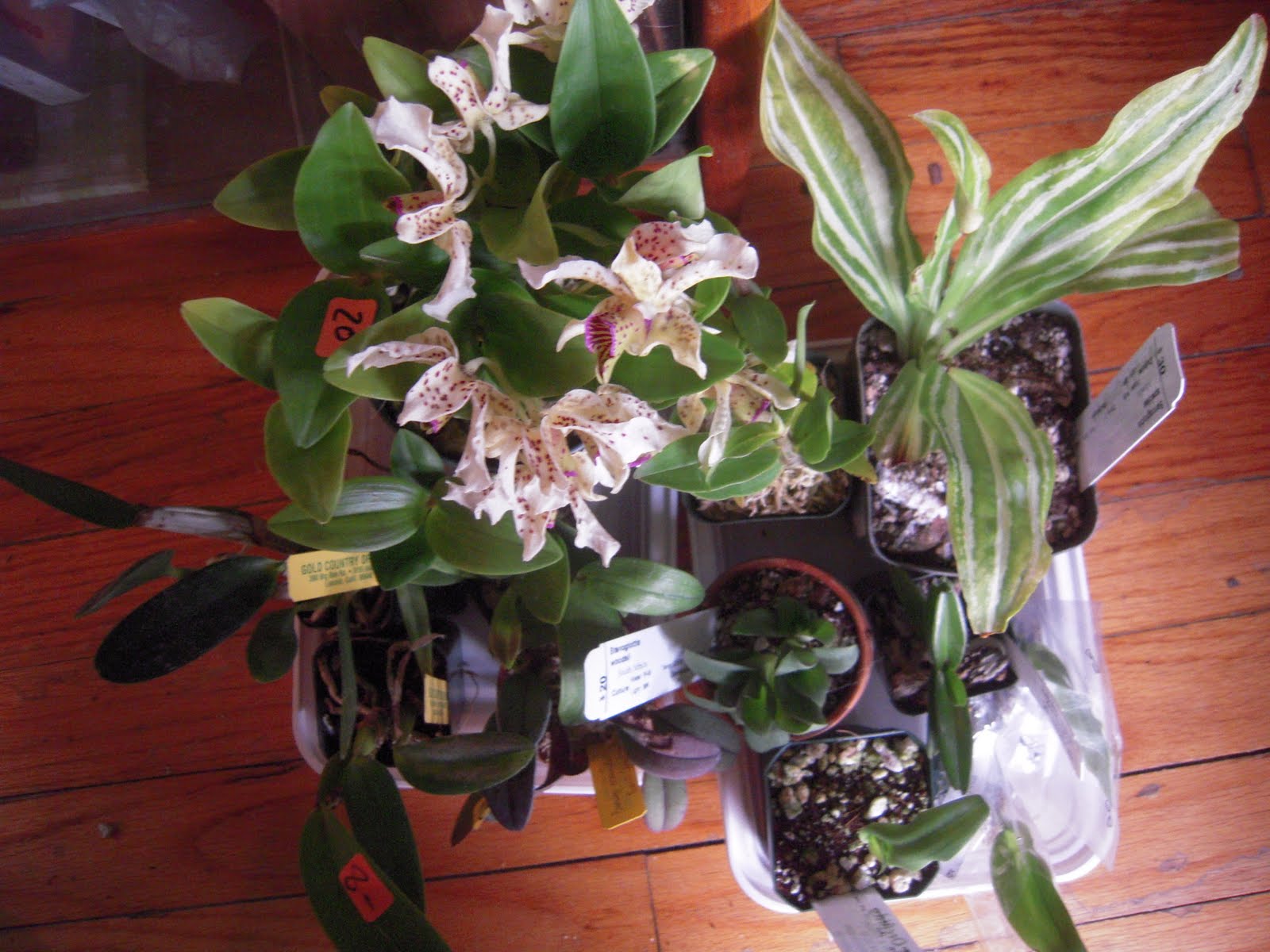
Spread out a bit, this haul fit in two plastic takeout tray/boxes, as seen above:
  • Angraecum leonis (an old favorite, a nice healthy plant)
  • Bulbophyllum frostii (could not resist another)
  • Gastrochilus japonicus (currently in flower)
  • Goodyeara pusilla (really gorgeous dark sparkly leaves)
  • Holcoglossum subulifolium (Oak Hill, a huge plant for cheap!)
  • Liparis bootanensis (a little underwhelming florally, but I may learn to love it)
  • Liparis viridiflora (replaces one I had for many years but managed to kill)
  • Macodes petula (yet another one...they are NOT the easiest jewels to maintain!)
  • Oeceoclades maculata (yes I know it's a weed, but I don't care)
  • Paphiopedilum purpuratum (Silva has a nice assortment of paph species)
  • Paphiopedilum Yakushiji (malipoense x weshanense) (compact, in spike!)
  • Phalaenopsis deliciosa (wanted one for years!)
  • Pholidota chinensis (one of my VERY favorite species)
  • Podochilus muricatus (I could not help myself but to get another...alas the one I got in March bit the dust)
  • Tolumnia Genting Volcano (a nice dark pink)
Most of these new guys have found places more or less OK for them but a few are hanging out with some of the SEPOS plants that still haven't found exactly the right spot. I also have to pot the bare-root Liparis. And since the beginning of the year I managed to acquire a number of other plants as well...shall record them soon.

Friday, June 24, 2011

Pretty Red Orchids!


I still think this is Potinara Ching Hua Flame 'Red Rose' but still can't be 100% sure -- it might just be an SLC Jewel Box clone, but I don't think so. The plant is too compact and neatly upright, and not very big, and the flowers have much better substance. This NOID came from a raffle following the New York International Orchid Show; Kawamoto Orchids was a vendor, and they do carry this clone, and the picture and description match my plant pretty well. (The original price tag matched their price at the time too.)

This is the best set of blooms it's ever had! Being very close under the lights helps...gee, getting lots of water and food seems to help too, not to mention air circulation in hot weather. Frankly I'm amazed to get such red red red flowers in summer, when cool weather usually produces brighter reds.

Now if only the rest of my mini catts would get in line...

Monday, May 23, 2011

SEPOS/Longwood Gardens 2011: My purchases


Another fantastic orchid show come and gone. We spent 3 hours in a car to get there from NYC, anticipating the beautiful things we'd see. And what do my friends and I do first? Why hit the sales tent of course.
  • Aerangis hyaloides -- an entire compot in flower!
  • Anoectochilus burmannicus
  • Anoectochilus albo-lineatus 
  • Bromheadia brevifoli (mounted, adorable pointy green leaves)
  • Bulbophyllum comingii
  • Cynorkis fastigiata (I know, I know, it's a weed, go away)
  • Dendrochilum javieri
  • Dendrobium normandbyense
  • Dend. tosaense
  • Dend. Angel Baby (fantastic awesome hybrid, and covered in buds)
  • Dend. Aussie Chip (another one, yes)
  • Habenaria medusa (yes I've lost my mind)
  • Podochilus muricatus (mounted, adorable rounded green leaves)
  • Stenoglottis woodii (adorable fat little green leaves)
  • (SLC Dream Cloud x BLC Love Sound)
About my usual ratio of species to hybrids, lately.
Once the shopping was done, I could begin the important business of taking lots and lots and lots of photographs. Lots and lots. Ooh, lots.


(All this happened in March, of course, and here I am only now remembering to finish & publish the post. So a few updates are going to overlap this...o well.)